Rules
2-4 players / 30-45 min (Basic) · 60-90 min (Professional)
Game Overview
Players become skilled adventurers belonging to an adventurer's guild, delve into a dungeon, and aim to gain more profit than anyone else. A great adventurer must not only defeat monsters, but also trade shrewdly with other adventurers.
Components
| Component | Contents |
|---|---|
| Damage/Score cards | 4 cards |
 Dungeon cards | 64 cards |
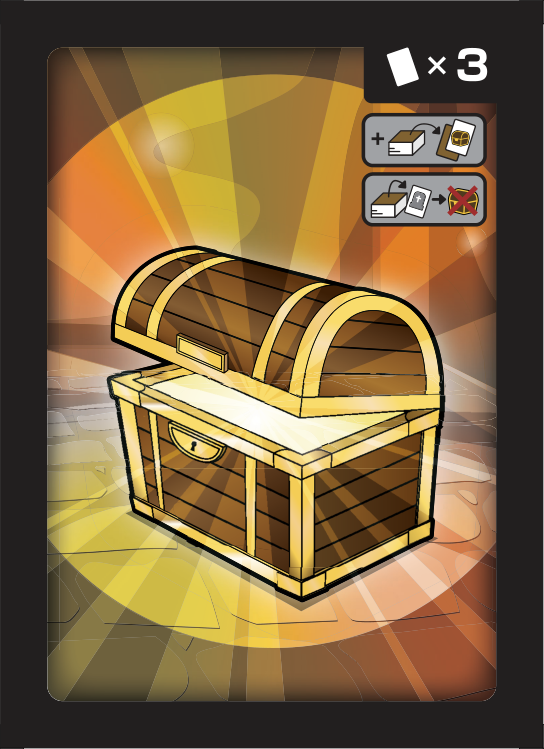 Treasure Chest cards | 3 cards |
| Score Summary cards | 4 cards |
| Coin tokens | 1G: 23, 2G: 21 |
| Cubes | 4 per color |
Dungeon Card Types
Dungeon cards fall into the following four types. Attributes areRed・Blue・Yellow・Green・Purplefive in total.
1. Normal Monster Cards
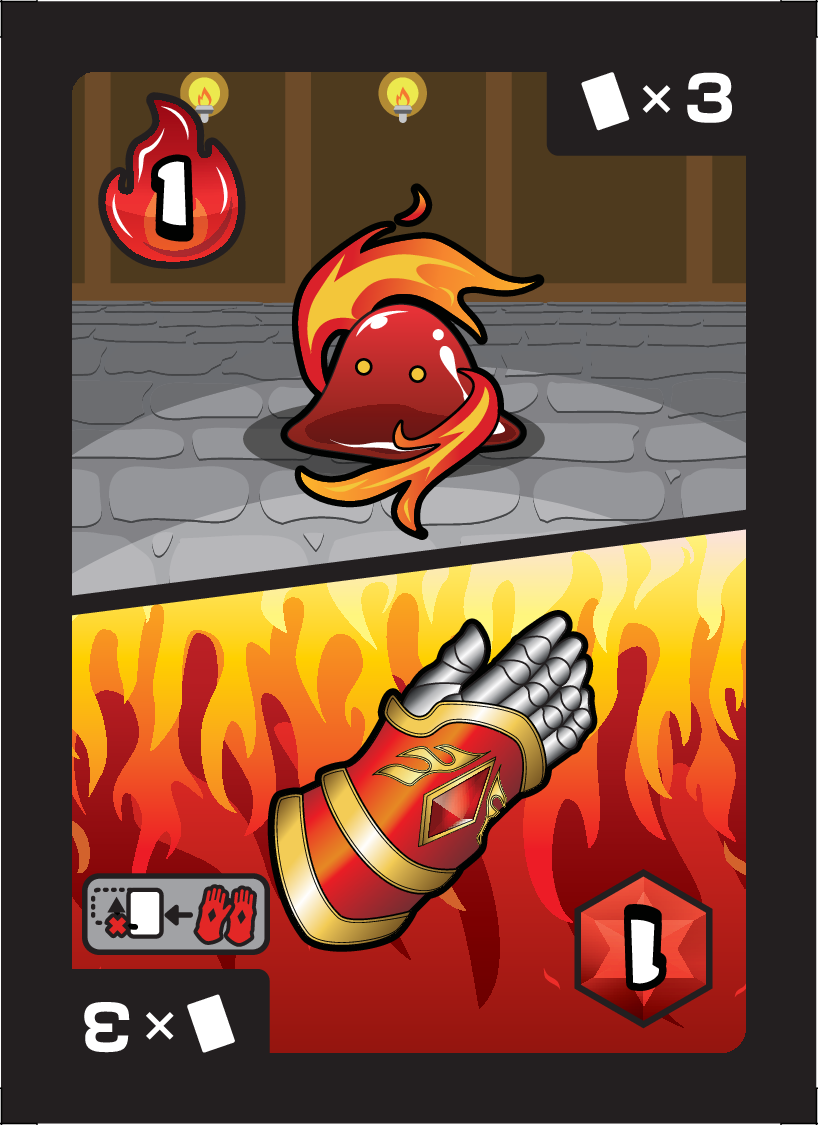
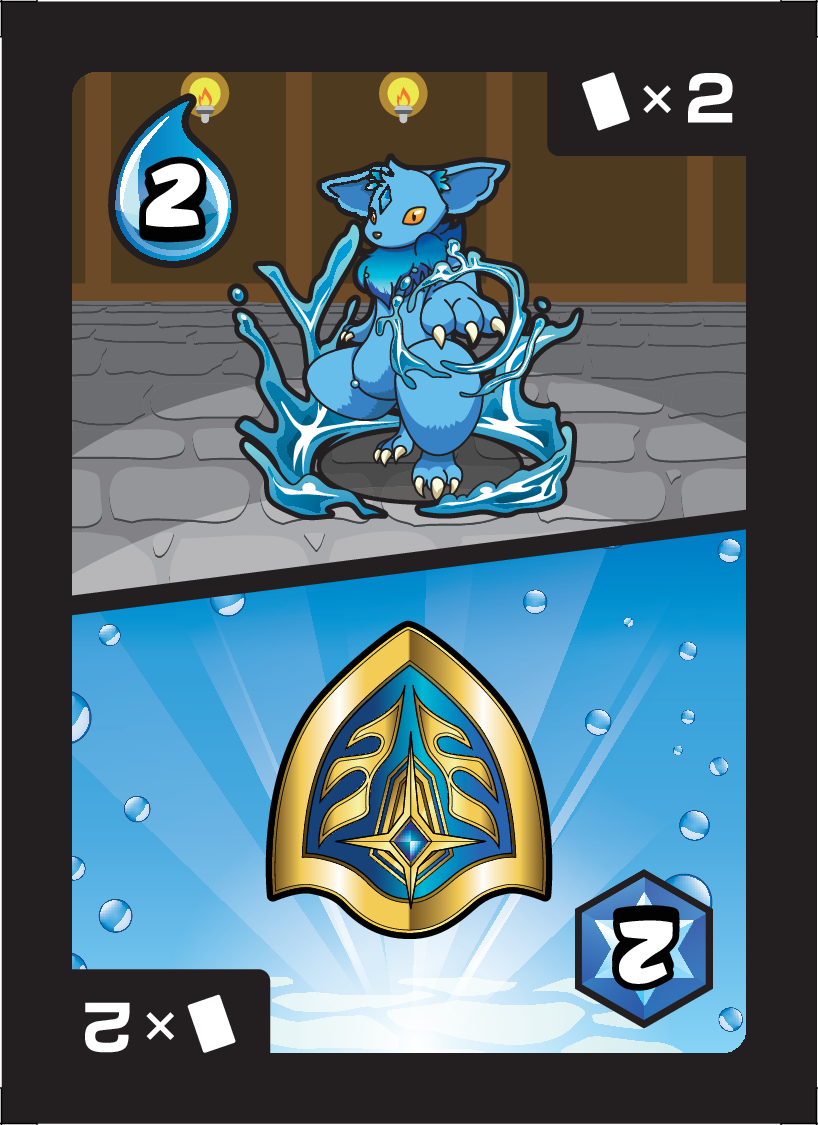
Each card shows the monster's attribute and attack power in the upper left, and the loot's effect value in the lower right. 10 cards per attribute, 50 cards in total.
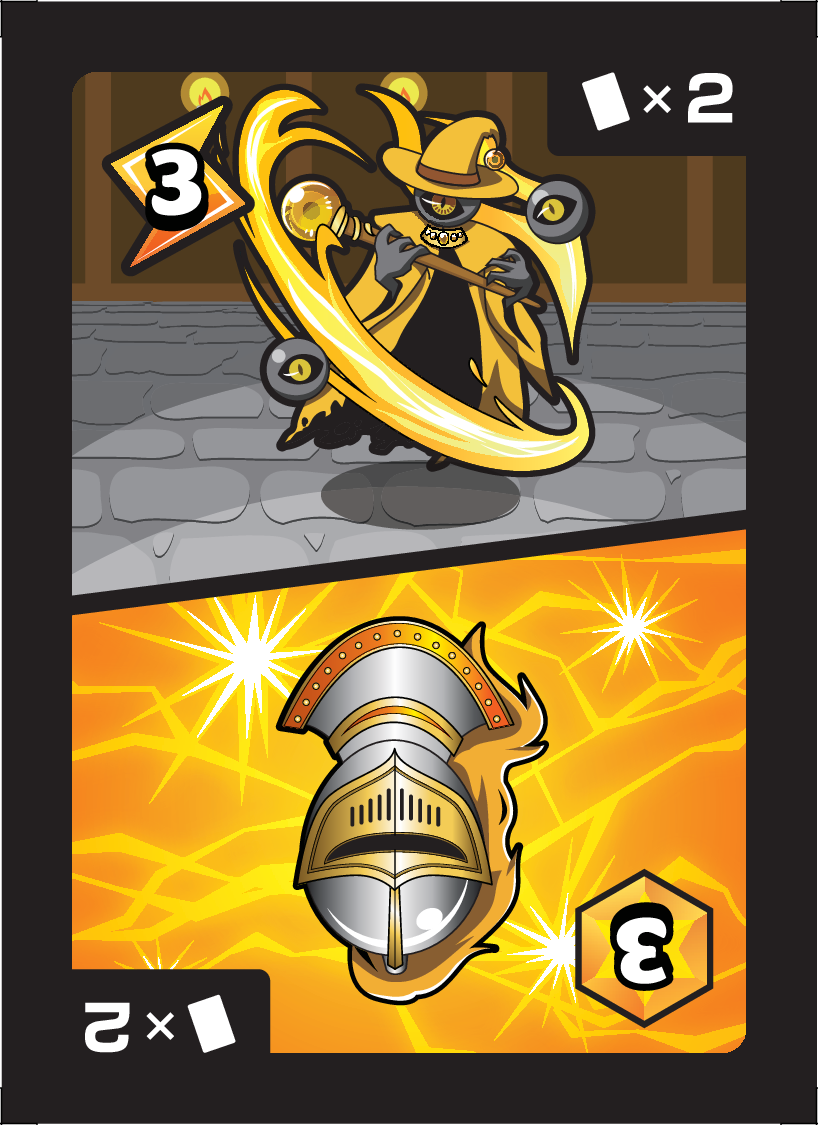
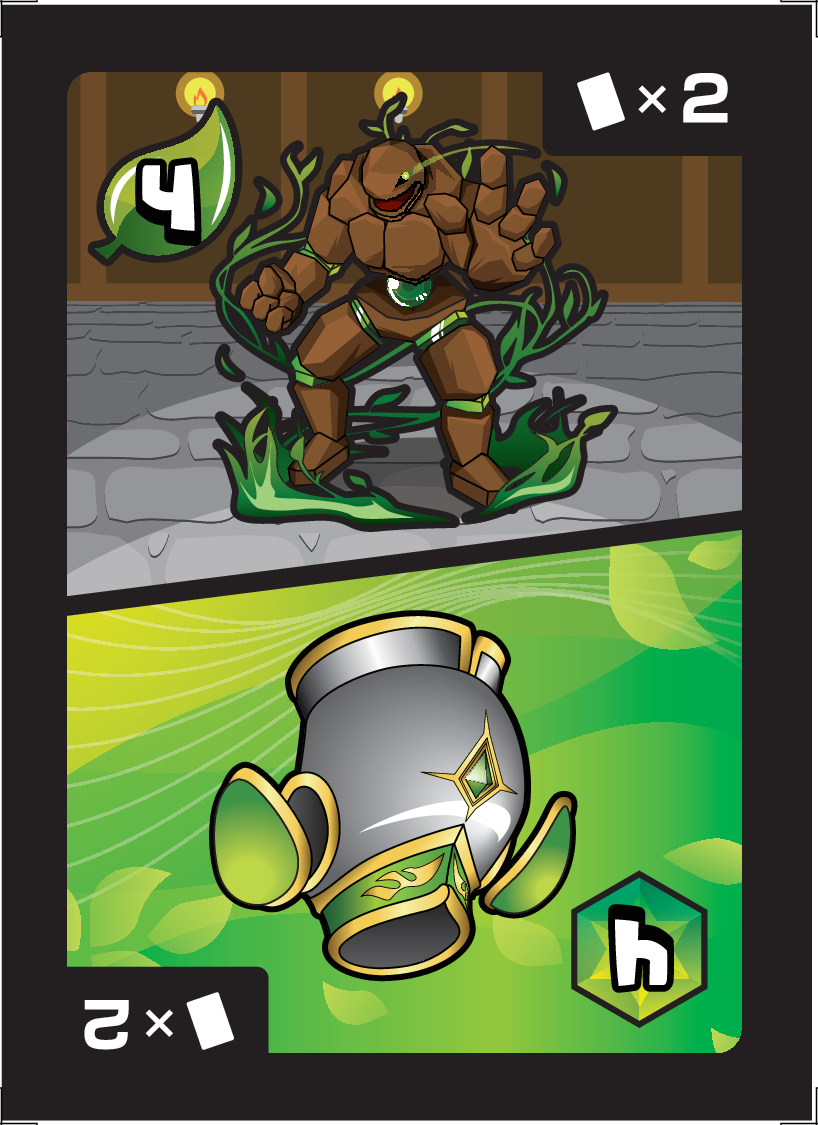
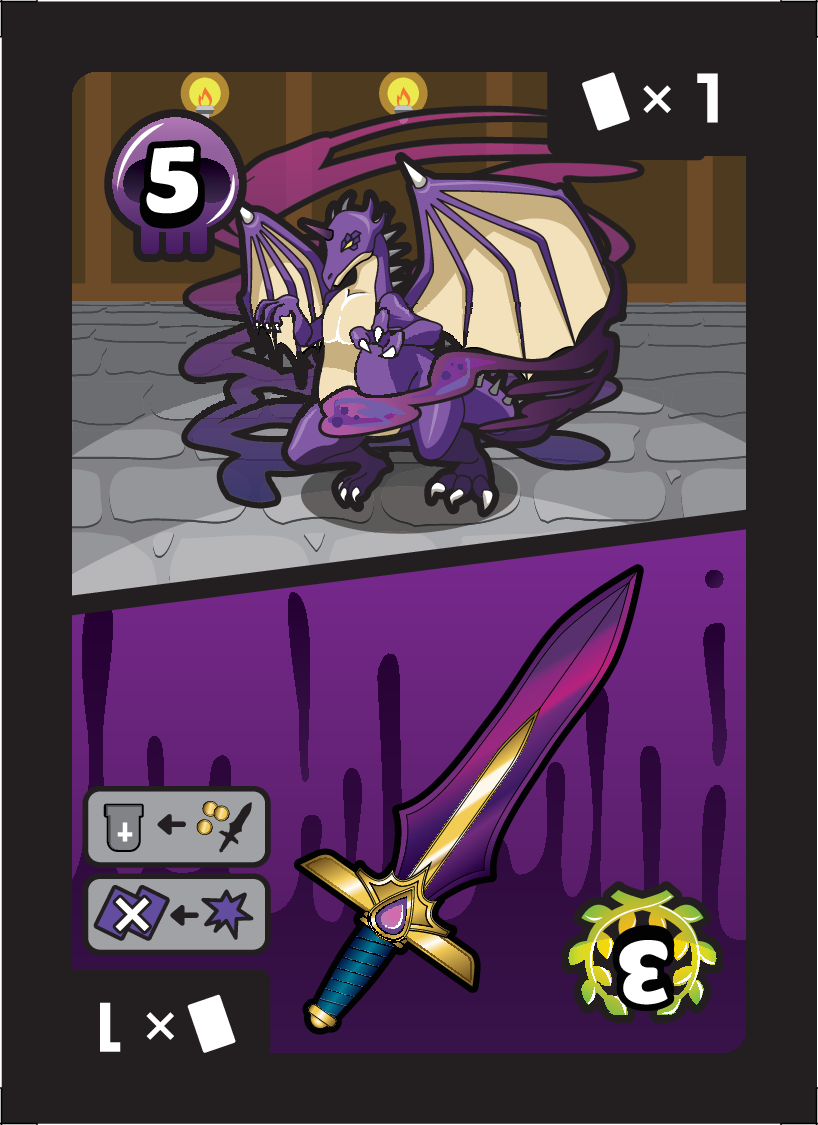
| Loot | Defense / Effect |
|---|---|
| Gauntlet | 1 defense / reusable as long as you have two gauntlets of the same color |
| Shield | 2 defense |
| Helmet | 3 defense |
| Armor | 4 defense |
| Sword | 3 victory points / infinite defense |
* Per attribute: 3 gauntlets, 2 shields, 2 helmets, 2 armors, 1 sword (10 cards per attribute). If you have two unused gauntlets of the same attribute, using one does not exhaust it and it can be used repeatedly. A third gauntlet is single-use.
2. Ghost Monster Cards
Monster cards with no loot depicted. One per attribute, 5 cards in total, carrying attribute and attack power info.
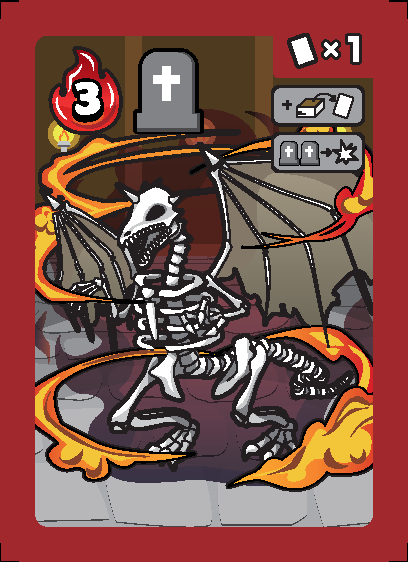
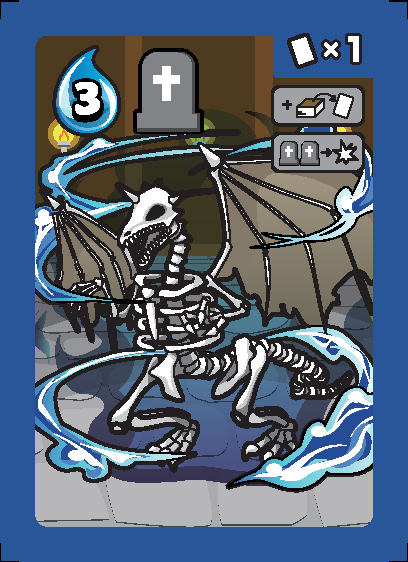
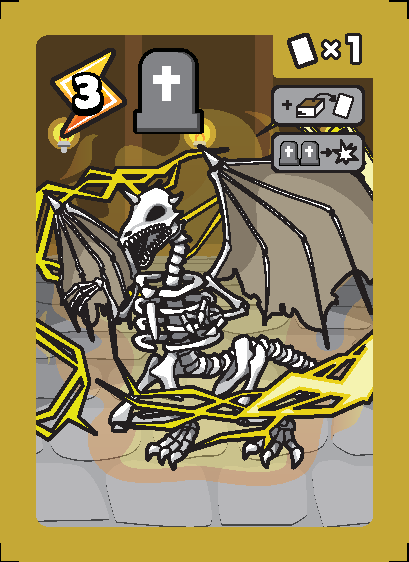
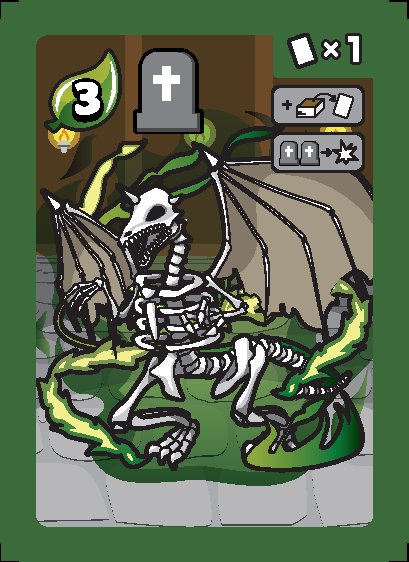
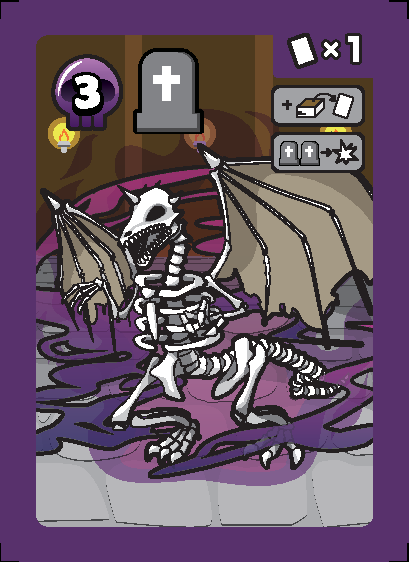
- Not included in the deck at the start; added to the discard pile the first time the deck runs out.
- If a ghost card is revealed from the deck and no burst occurs, you must explore once more.
- When two ghost monster cards are revealed, the burst condition is met.
- In 2-player games: Include them in the deck from the start.
3. Artifact Cards
Cards that grant the victory points shown in the upper left at scoring just by holding them. However, players whose life is 0 or below cannot gain these points.
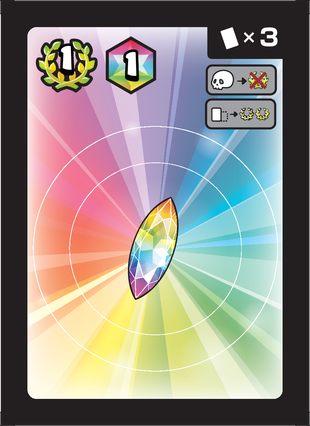
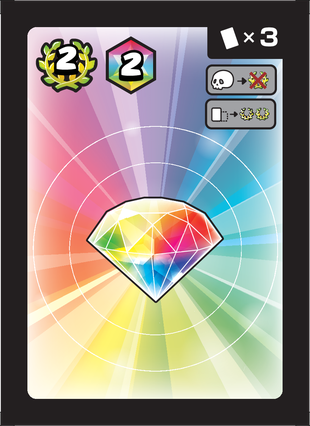
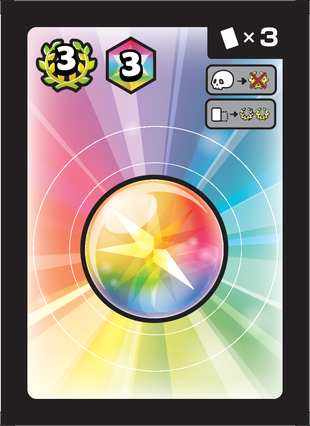
- There are three cards worth 1, 2, and 3 victory points each.
- Players whose life drops to 0 or below lose all artifact cards.
4. Treasure Chest Cards
Extra cards; 3 of them are always shuffled into the dungeon deck. See the4. Treasure Chest Cardssection for details.
Setup
- Each player chooses a player color from red, blue, yellow, and green, and takes the damage card, cubes, and 15G in coins (five 1G and five 2G) of that color, plus a score summary card if desired. Then place one gauntlet card of the same attribute as your player color in front of you.
* In 3- and 4-player games, place the cube on the 40 space of the damage card; in 2-player games, on the 30 space.
- Shuffle the dungeon cards face down after removing the 5 ghost cards, and place them in the center as the deck. The area beside it is the discard pile. Place 5G in coins nearby as the guild deposit.
- Determine the first player by any method and begin the Explore phase.
Turn Flow
The active player draws from the deck and keeps exploring until a burst occurs. If a burst occurs, proceed to the Burst phase; otherwise, you may proceed to the Market phase.
Explore Phase
Draw from the deck and keep exploring until a burst occurs.
- The active player draws the top card of the deck and reveals it in the center (the discovery area). If cards are already there, place it beside them.
- If two monsters of the same attribute, or two ghost monster cards, are revealed in the discovery area, a burst occurs . The Explore phase ends immediately and the Burst phase begins. If the revealed card is a ghost, you must explore once more.
- If no burst occurs, the active player may choose to explore again or proceed to the Market phase.
If the deck has 0 cards, perform the following before the steps above.
- In 3- and 4-player games: Shuffle all discard cards face down to form a new deck. If this is the first time, add the 5 ghost monster cards to the deck.
- In 2-player games: If there are cards in the discovery area, begin the Market phase; otherwise, begin the Scoring phase.
Burst Phase
All players take attacks from monsters and the deposit is redistributed.
- Attacks of the attributes of the two monsters that triggered the burst hit all players. The damage is the sum of the two monsters' attack power. The active player takes 1 additional damage.
* In a burst caused by two ghosts, attacks of different attributes occur simultaneously. If two burst conditions are met at once by ghosts, it may result in attacks from three monsters.
- Each player may use any number of unused equipment of the same attribute as the attack to reduce damage by the total defense value. Used equipment and artifacts are turned sideways (exhausted).
* If you have two unused gauntlets (defense 1) of the same attribute, using one does not exhaust it and it can be used repeatedly. A third gauntlet is single-use.
- Each player moves their cube on the damage track according to the damage taken to show remaining life. If any player's life reaches 0 or below, the Burst phase ends immediately and the Scoring phase begins.
- Divide the guild deposit in the center equally among all players. If there is a remainder, the player with the lowest life takes all of it. If multiple players tie for lowest life, the one closest clockwise from the active player takes it. Then discard all cards in the discovery area and the next player clockwise begins their turn.
* If a burst occurs, you cannot perform the Market phase.
Market Phase
The active player prices and sells the loot discovered during the Explore phase at any value.
- First, if a ghost monster card is in the discovery area, discard it. For each card revealed in the discovery area, the active player may place 0 or any number of coins from their funds to set a price.
- In 3- and 4-player games, starting from the player to the active player's left and going clockwise, every player except the active player performs a purchase once.
* In 2-player games: After the non-active player (opponent) performs one purchase, the active player may purchase one card, then the opponent performs one more purchase.
- Then, for each card remaining in the discovery area, perform the following.
- Cards with coins on them (priced): The active player must pay the coins on the card to the guild deposit and purchases the card.
- Cards without coins (unpriced): Discarded.
- The next player clockwise begins their turn.
About Purchasing
During a purchase, you choose whether or not to buy one card from the discovery area. If you buy, you give the active player coins equal to the card's price, and the coins placed on the card also return to the active player.
However, cards without coins (unpriced) can be bought for a flat 5G, paid to the guild deposit in the center. Of course, you cannot buy if you do not have the required coins.
Treasure Chest Cards
3 treasure chest cards are always shuffled into the dungeon deck, in both the basic rules and the Professional expansion.
Handling in the Explore Phase
If the active player reveals a treasure chest card, theyprivately peek at the next card in the deck. The handling depends on the peeked card.
- If it is a ghost monster card: Immediately reveal that ghost into the discovery area and remove the treasure chest card from the game. Removed treasure chest cards are never used again in this game. Afterwards, perform the same handling as revealing a ghost through normal exploration (forced re-explore, burst check).
- If it is a normal monster or artifact: Do not reveal the peeked card; place it face down under the drawn treasure chest card. Place this pair (the chest and the hidden card) together in the discovery area.
* Treasure chest cards do not trigger bursts. The chest itself counts toward the reveal limit, but the card hidden under it is not treated as revealed.
Handling in the Market Phase
The card hidden by a treasure chest is priced and purchased just like other loot. Players other than the active player cannot know what the card is until it is purchased.
- Until purchased, it is treated as normal loot.
- The purchasing player does not gain the hidden card; both the treasure chest card and the hidden card are sent to the discard pile.
| Situation | Process |
|---|---|
| When you draw a treasure chest | Privately peek at the next card |
| The peeked card is a ghost | Reveal it immediately and remove the chest from the game |
| The peeked card is a normal monster or artifact | Place it face down under the chest |
| The chest is purchased at market | Buyer gains nothing; both cards go to the discard pile |
Game End (Scoring Phase)
The game ends when any of the following occurs.
- During the Burst phase, a player whose life reaches 0 or below appears.
- In 2-player games: when there are no cards in the deck and the discovery area.
Calculate each player's score according to the steps below to determine the winner.
1. Points by Life Ranking
All players whose life is 0 or below discard all artifact cards they hold. Rank players by life (including those at 0 or below), and from the top they gain 4, 0, -2, -4 points .
* If players tie in rank, two players split the sum of that rank and the next rank's points; three players all get the next rank's points; four players all get 0 points.
2. Points from Equipment
* Points from equipment are gained regardless of whether it is exhausted.
- 5-Color Set Bonus: If you have equipment of all 5 attributes (red, blue, yellow, green, purple), you gain 5 points × the number of equipment in the attribute with the fewest.
- Per-Color Variety Bonus: Per attribute, gain 0, 1, 3, 7, or 15 points according to the number of equipment types held.
- Sword Bonus: 3 points per sword.
3. Points from Artifacts
* Only for players with life of 1 or more
Victory points equal to the printed value (1-3).
4. Points from Coins
1 victory point per 5G held (fractions discarded).
Professional Expansion
The Professional expansion adds job item cards to the basic rules. Play time is 60-90 minutes, for ages 12 and up.
Job Item Cards
By acquiring job item cards and raising their level, you can gain various effects. There are 12 cards in total.
Job Level
Job level indicates proficiency in each job. When acquired, it starts at LV0 and can be raised up to LV4.
- At the start and end of your turn, or when acquiring a job item card, you may spend the required EXP to raise any number of job levels. However, when acquiring a card, you can only raise the level of the acquired job.
- The EXP required to level up is shown on the EXP card.
| LV | EXP Required |
|---|---|
| LV.1 | 2 |
| LV.2 | 4 |
| LV.3 | 8 |
| LV.4 | 13 |
* Raising from LV0 to LV1 costs 2 EXP, LV1 to LV3 costs 4 EXP, and LV3 to LV4 costs 13 EXP (intermediate levels are raised in order).
Gaining EXP
- At the end of the Explore phase, the active player gains EXP equal to the number of cards revealed. However, if a burst occurs, EXP for the attacking monsters is not gained (basically revealed cards − 2).
- Cards placed face down by treasure chest cards are not counted.
- They are sent to the discard pile after the Burst or Market phase ends.
Job Item Auction
At the very end of the Burst phase (right after the deposit redistribution), the player who caused the burst picks one of the revealed job item cards and auctions it. Unchosen cards go to the bottom of the deck.
Job item auction steps:
- All players secretly hold any amount of coins (0 allowed) in their hand and reveal simultaneously.
- The highest bidder pays their coins to the deposit, acquires the job item card at LV0, and may level up if desired.
- If there is a tie for the highest bid, the active player takes priority, then the player whose turn is closest (e.g., if everyone bids 0G, the active player acquires it).
Changes from the Basic Rules
- When a burst occurs, the active player takes 1 damage that cannot be reduced by armor or artifacts.
- Abolish the 3- and 4-player rule of "when a sword is purchased, add the corresponding color's ghost monster card to the discard pile"; instead, once the deck enters its second cycle, shuffle all 5 ghost monster cards into the deck.
- In 2-player setup, shuffle all 5 ghost monster cards into the deck and set starting life to 30.
- A reveal limit is set for the active player in the Explore phase (up to the number of equipment and artifact colors held + 1; 2 at the start, up to 7 at most).
- When a sword is used to defeat a monster during a burst, that monster is placed face down instead of being discarded (it counts as explored, and you gain EXP for it).
Glossary
- Burst
- An event that occurs when two monsters of the same attribute or two ghost monster cards are revealed in the discovery area. All players take damage and the deposit is distributed.
- Discovery Area
- The area in the center where revealed cards are placed. Cards drawn during the Explore phase go here.
- Guild Deposit
- Shared coins placed in the center. 5G is placed at the start; payments for unpriced cards and auction payments during bursts accumulate here, and it is distributed among players on a burst.
- Life
- The player's remaining health, shown by a cube on the damage card. Reaching 0 or below means elimination (or game end).
- Loot
- Equipment (gauntlet, shield, helmet, armor, sword) depicted in the lower right of normal monster cards. Acquired by purchasing during the Market phase.
- Equipment
- Acquired loot. Used during the Burst phase to defend against attacks of the matching attribute. Used equipment is turned sideways.
- Artifact
- A card that grants victory points (1-3) at scoring just by holding it. Players whose life is 0 or below lose it.
- Ghost Monster
- A monster card with no loot. One per attribute, 5 in total. Revealing one forces a re-explore, and revealing two causes a burst.
- Treasure Chest Card
- An extra card always shuffled into the deck. The drawing player secretly peeks at the next card, and the handling changes depending on its contents, adding a gambling element.
- Job Item Card
- A card from the Professional expansion. Acquiring and leveling it up grants various skill effects and victory points. Acquired by auction during a burst.
- EXP
- A resource consumed to raise job levels in the Professional expansion. Gained equal to the number of cards revealed at the end of the Explore phase.
- Market Phase
- The phase where the active player prices discovered loot and other players purchase it. Unpriced cards are force-bought by the active player or discarded.